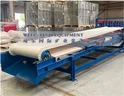
Alluvial gold plant for sticky material
An alluvial gold plant designed for sticky materials (typically ore mixed with a large amount of clay) mainly relies on trommel scrubber as the core equipment to remove sticky clay, and is matched with vibrating feeders, centrifugal concentrators and other auxiliary equipment to achieve efficient gold extraction. The following is a detailed introduction to its core equipment, typical process flow, practical cases and key design points:
Core Equipment Configuration
| Equipment | Function | Key Advantages for Sticky Materials |
|---|---|---|
| Trommel Scrubber | The core equipment for removing sticky clay. It rotates continuously with water injection inside; the ore collides with the inner lining during rotation, and the sticky clay is scattered and washed away by water. | The inner lining can be rubber or manganese steel. Rubber linings are easy to install and replace, while manganese steel is more economical. It can handle ores with large particle sizes and effectively break up clay agglomerates. |
| Vibrating Feeder with Grizzly Bars | Feeds raw ore evenly into the trommel scrubber and pre-screens large stones (e.g., >75mm) to prevent blockage of the scrubber. | The grizzly bar sieve can be customized according to the particle size of the ore, avoiding the impact of large impurities on the clay-washing effect. |
| High-Frequency Vibrating Screen | Classifies the ore after clay washing into different particle size ranges (e.g., 0 - 6mm and 6 - 12mm) to adapt to subsequent gold recovery equipment. | High vibration frequency can prevent sticky residues from clogging the screen mesh and improve classification accuracy. |
| Centrifugal Concentrator | Performs primary concentration of gold from the slurry after clay washing, especially for fine gold particles (down to 40 microns). | Strong centrifugal force can quickly separate gold (a heavy mineral) from the remaining fine sand and clay particles. |
| Sluice Box | Recovers gold concentrate from classified ore and acts as a backup to recover gold from tailings. | It can be customized in length and width. The internal gold carpet or riffles can trap gold particles, and it is suitable for matching with different particle size ores after clay removal. |
| Shaking Table | Performs final purification of the concentrate from the centrifugal concentrator or sluice box to improve gold purity. | The layered separation based on density difference can effectively separate gold from the remaining tiny clay and sand impurities. |
Typical Process FlowTaking the common 100 - 200 TPH (tons per hour) plants as examples, the process for sticky alluvial gold ore is as follows:
Feeding and Pre - Screening: Excavators or loaders send raw ore (mixed with sticky clay and large stones) into the vibrating feeder. The feeder screens out large stones (e.g., >75mm) through grizzly bars, and the qualified ore (<75mm) is evenly fed into the trommel scrubber.
Clay Washing: The trommel scrubber rotates with continuous water injection. The water - to - ore ratio is usually 3:1 (3 cubic meters of water per ton of ore) to ensure that the sticky clay is fully washed away. The washed waste clay and tailings are discharged with water.

Rotary Scrubber
Classification: The ore after clay removal is sent to a high - frequency vibrating screen to be divided into multiple particle size fractions. This avoids the influence of uneven particle sizes on gold recovery efficiency.
Gold Recovery: Different particle size ores enter corresponding sluice boxes to collect primary gold concentrate. For fine gold, the slurry is first sent to a centrifugal concentrator for enrichment, and then the concentrate is sent to a shaking table for final separation to obtain high - purity gold.
Tailings Treatment: The tailings from the sluice box are re - screened to recover scattered gold particles, reducing gold loss.
Practical Project Cases
200 TPH Clay Alluvial Gold Wash Plant: This plant is designed for ores with 150 - 250mm large stones and 0 - 12mm gold particles. It uses a trommel scrubber with a rubber lining, matching two sets of vibrating screens and sluice boxes. The water - to - ore ratio is 3:1, and the gold recovery rate is ensured by multi - stage tailings recovery.
100 TPH Ghana Alluvial Gold Plant: Aimed at sticky clay - rich alluvial gold in Ghana, it adopts a trommel scrubber + centrifugal concentrator + shaking table process. Chinese engineers were dispatched to guide on - site installation, and the gold grading rate reached over 80%.

Sticky Gold Plant

Gold Centrifugal Concentrator
Key Design Considerations
Water Supply System: Sufficient water is the key to removing sticky clay. The water pump system should be configured according to the 3:1 water - to - ore ratio standard, and the water pipe layout should ensure uniform water injection in the trommel scrubber.
Power Matching: Calculate the total power of all equipment and multiply by 1.35 to select a generator to avoid insufficient power affecting the continuous operation of the trommel scrubber and vibrating equipment.
Mobility or Fixity: For small - scale mines or mobile mining scenarios, trailer - mounted or skid - mounted equipment can be selected. The trommel scrubber and concentrator are equipped with wheels for easy transfer, which is suitable for scattered sticky alluvial gold mining areas.
Lining and Screen Selection: For high - viscosity clay, rubber linings are recommended for the trommel scrubber to reduce ore adhesion; the screen of the vibrating screen can choose polyurethane or stainless steel to improve wear resistance and anti - clogging performance.