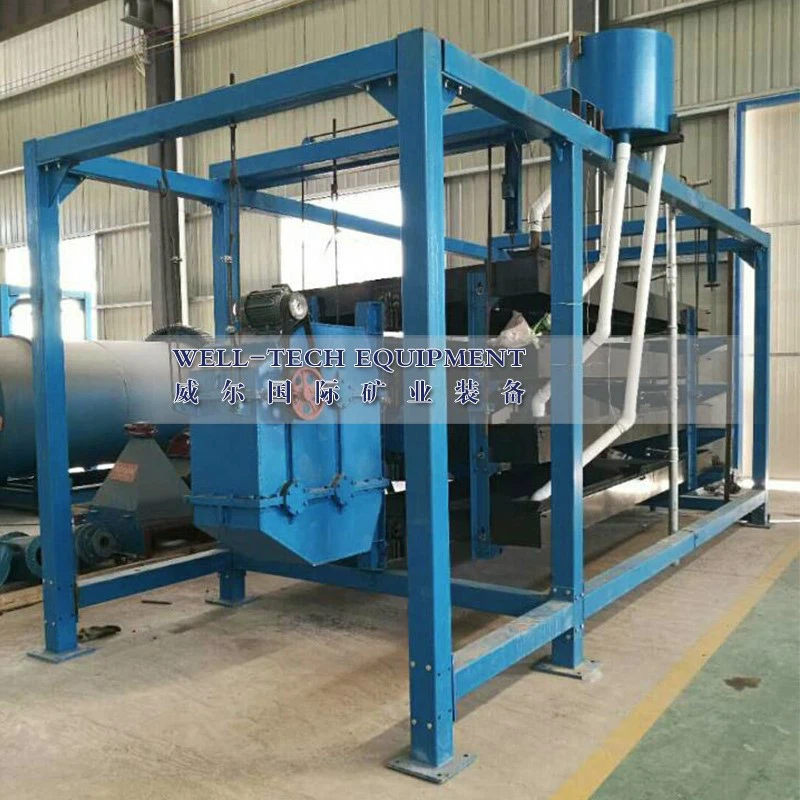
Shaking tables are commonly used to separate aluminium and copper particles of size -2 mm, as they have higher recoveries than other gravity separators. The particles are fed onto the top of the table surface and their relative densities cause them to be stratified or separated. The table is vibrated, accelerating the settling rates and allowing the heavier particles to become stratified near the bottom of the table, and the lighter particles, such as copper, to settle near the top. The copper can then be removed from the top, while the aluminium is collected from the bottom. The advantage to using a shaking table is that it requires minimal energy, it is relatively low cost and it is effective for particles of a size -2 mm.
The shaking table is an effective gravity separator that can separate any two particles of different densities as long as each particle's size is not more than 2mm. It works by vibrating the table at high speeds, causing lighter particles to move up and heavier particles to move down the table. Depending on the kind of aluminium and copper particles, you may need to adjust the speed of vibration and the tilt of the table further to separate these particles effectively.