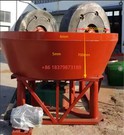
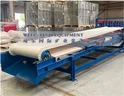
small scale gold processing plant
1. Ore Testing & Feasibility (Critical First Step)
Before buying any equipment:
Sample & assay: Test gold grade, particle size, liberation, and gangue minerals (quartz, sulfides, clay).
Testwork:
Alluvial: Sieve analysis + gravity separation test (panning, sluice, concentrator)
Hard rock: Crush/grind + gravity/flotation/cyanide leach tests (bottle roll, diagnostic leach)
Key outputs: Recovery rate, optimal grind size, reagent needs, and tailings toxicity.
2. Choose Process Flow (By Ore Type)
A. Alluvial/Placer Gold (Free, coarse gold; low clay)
Simplest & lowest cost:
Washing: Trommel scrubber → vibrating screen (remove gravel, clay)
Gravity concentration: Sluice box → centrifugal concentrator (Knelson/Falcon) → shaking table
Cleaning: Gold panning or small amalgamation (avoid mercury; use borax method)
Smelting: Small furnace to produce gold bullion Recovery: 70–90% (coarse gold); 50–70% (fine gold)

5tons per hour rock gold gravity separation
B. Hard Rock Gold (Veins, lodes; locked gold)
1) Gravity-only (Free-milling, coarse gold)
Crushing: Jaw crusher (PE250×400, 5–20 t/h) → hammer mill → vibrating screen
Grinding: Small ball mill (φ1.5×3m) → spiral classifier (closed circuit, -200 mesh 70–80%)
Concentration: Centrifugal concentrator → shaking table
Recovery: 60–80% (free gold only)
2) Gravity + Flotation (Sulfide-associated gold: pyrite, chalcopyrite)
Add flotation after grinding: Agitator → flotation machine (XCF-40) → gold-sulfide concentrate
Recovery: 85–90%
3) Cyanidation (Fine, low-grade, or refractory gold; >90% recovery)
Leaching: CIL (Carbon-in-Leach) or CIP tanks (0.05% cyanide, pH 10–11 with lime)
Recovery: Activated carbon → elution → electrowinning → smelting
Note: Strict environmental controls; many regions ban mercury.
3. Equipment Selection (1–20 t/h Example)
Core Equipment List (Hard Rock, 10 t/h)
Key Selection Tips
Modular/mobile: Containerized plants (5–50 t/h) for remote sites; fast setup (2–4 weeks).
Power: Diesel generator (20–100 kVA) or solar + battery; ball mills are the biggest load.
Water: 2–5 m³/t ore; recycle 70–80% with thickener + dewatering screen.
4. Site Layout & Infrastructure
Layout Principles
Linear or L-shaped: Minimize conveyor length; flow: ore bin → crushing → grinding → concentration → tailings.
Foundations: Reinforced concrete for crushers/mills; anti-vibration pads.
Essential Infrastructure
Water: Borehole, river, or trucked supply; storage tank (50–200 m³).
Power: Generator shed, transformers, wiring (IP65 for wet areas).
Tailings: Pond or dry stack (thickener + dewatering screen); line with clay/HDPE to prevent leakage.
Access: Gravel road for ore delivery and equipment maintenance.
5. Installation & Commissioning
Civil works: Clear, level, pour foundations (7–14 days).
Equipment install:
crushers → mills → concentrators → tanks
Align shafts, tighten bolts, install guards
Piping & wiring: Slurry lines (rubber-lined), water pipes, electrical cables.
Trial run (7–14 days):
Dry run: No ore; test motors, belts, pumps
Wet run: Water only; check leaks, flow
Ore trial: 50% capacity; adjust grind size, water flow, reagent dosage
Optimize: Tune for maximum recovery (target: 80–95% depending on ore).
6. Compliance, Safety & Environment
Legal
Mining license, environmental permit, waste discharge approval.
Cyanide: Special license; storage in secure, labeled tanks.
Safety
PPE: Helmets, gloves, goggles, respirators (for cyanide/dust).
Training: Operators trained on equipment, chemical handling, emergency procedures.
Environment
No mercury: Use borax, gravity, or cyanide (with proper controls).
Tailings: Neutralize cyanide (with bleach or hydrogen peroxide) before discharge.
Dust suppression: Water sprays or bag filters at crushing stage.
7. Cost Estimate (10 t/h Hard Rock Plant)
Equipment: $100,000–$200,000 (gravity-only)
Civil/Infrastructure: $30,000–$60,000
Installation/Commissioning: $15,000–$30,000
Total: $125,000–$340,000 (excluding mining, land, and labor)
8. Quick Start Checklist
Test ore and confirm recovery potential
Select flowsheet (gravity, flotation, or CIL)
Order modular equipment (preferred for speed)
Prepare site: water, power, tailings
Install and commission
Train staff and start production