Tajikistan polymetallic ore dressing process
Tajikistan is located in the ancient Asian mineralization area, with good mineralization conditions and great resource potential. At present, there are more than 600 metal and non-metal deposits that have been explored and are to be developed. The main minerals are coal, uranium, gold, silver, lead, zinc, antimony, mercury, tin, rock salt, etc. The secondary minerals are oil and natural gas, copper, molybdenum, iron, fluorite, phosphorite, etc.
Tajikistan is located in the Paleo-Asian metallogenic belt, with good mineralization conditions and great resource potential. Currently, there are more than 600 metal and non-metallic deposits that have been explored and are yet to be developed. The main minerals are coal, uranium, gold, silver, lead, zinc, antimony, mercury, tin, rock salt, etc. Secondary minerals include oil, natural gas, copper, molybdenum, iron, fluorite, phosphorite, etc.

Mineral composition Metallic minerals: mainly sulfide ores (chalcopyrite, galena, sphalerite, pyrite), containing scheelite (CaWO₄) and trace amounts of natural gold and silver minerals. Gangue minerals: quartz, calcite, fluorite, etc., often closely associated with valuable minerals. Embedding characteristics: The mineral particle size is uneven, some scheelite is fine-grained impregnation (0.02~0.1mm), and sulfide minerals are mostly medium-fine aggregates. 2. Difficulties in sorting Sulfide minerals have similar floatability: The flotation separation of copper, lead and zinc sulfide ores requires precise control of reagent conditions. Scheelite has similar density to gangue: calcareous gangue such as fluorite and calcite interferes with the re-selection and flotation of scheelite. Precious metal recovery: Gold and silver are often wrapped in sulfide minerals and need to be fully dissociated by fine grinding.

2. Core process design 1. Crushing and grinding Three-stage crushing: Coarse crushing: Jaw crusher crushes the raw ore to ≤150mm. Medium crushing: Cone crusher produces particles ≤50mm. Fine crushing: High pressure roller mill further crushes to ≤10mm.

Two-stage closed-circuit grinding: First stage grinding: ball mill and spiral classifier are used together to grind to -200 mesh, accounting for 60%~65%, and sulfide ores are floated first. Second stage grinding: the flotation tailings are re-grinded to -400 mesh, accounting for 75%~80%, releasing fine-grained scheelite and precious metals. 2. Pre-selection and discarding of heavy medium separation: heavy medium cyclone is used for coarse-grained ore (+2mm), and the separation density is set to 2.9-3.1g/cm³, and 30%-40% of low-grade waste rock is discarded in advance. 3. Sulfide ore separation mixed flotation desulfurization: adjustment agent: lime (pH 11~12) inhibits pyrite, and copper sulfate activates sphalerite. Collector: butyl xanthate + black medicine combination to collect copper, lead and zinc sulfide minerals. Process: 1 roughing 2 sweeping 1 fine, producing mixed sulfur concentrate.
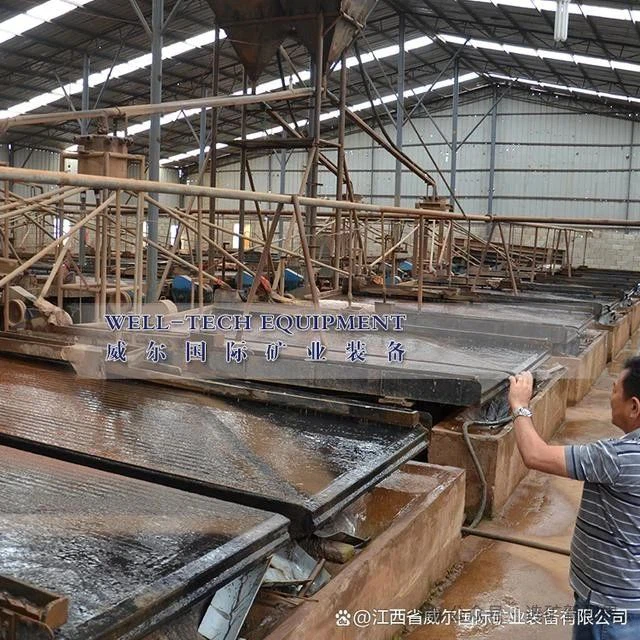
Copper-lead-zinc separation: Zinc suppression and copper-lead flotation: lime + sodium cyanide suppress sphalerite, and float copper-lead mixed concentrate. Copper-lead separation: After activated carbon dedoping, potassium dichromate suppresses galena and floats chalcopyrite. Zinc flotation: sulfuric acid activates sphalerite, butyl xanthate captures, and zinc concentrate is produced. 4. Scheelite recovery flotation process: Roughing: sodium carbonate slurry is adjusted to pH 9-10, water glass suppresses silicate, oleic acid soap captures scheelite, and heated to 35-40℃ to enhance selectivity. Concentration: 4~5 times of concentrating, gradually increase the concentration of water glass to suppress residual fluorite. Gravity selection auxiliary: For the coarse-grained scheelite (+0.1mm) in the flotation tailings, a shaking table is used for supplementary recovery.

Precious metal recovery sulfur concentrate reprocessing: Grind the gold-containing sulfur concentrate to -400 mesh, accounting for 90%, and use cyanide leaching (NaCN concentration 0.05%~0.1%) to recover gold and silver, and replace zinc powder to obtain precious metal mud. 6. Tailings treatment concentration and dehydration: After the tailings are settled in the concentrator, they are dehydrated by a vacuum filter and the filter cakes are stored. Return water utilization: The overflow water returns to the grinding and flotation process, and the new water is only used for reagent preparation. III. Process flow diagram
Raw ore → three-stage crushing → pre-screening → heavy medium discarding → first-stage grinding
→ sulfide ore mixed flotation → copper, lead and zinc separation → copper concentrate, lead concentrate, zinc concentrate
↓
Tailings → second-stage grinding → scheelite flotation (roughing-concentrating) → tungsten concentrate
↓
Final tailings → concentration and dehydration → tailings pond storage
IV. Key Operation Points Grinding particle size control: The first stage of grinding needs to ensure that the sulfide minerals are fully dissociated, but avoid over-grinding to cause mud interference. The second stage of grinding aims at the dissociation of scheelite, and strictly controls the classification efficiency of the cyclone. Optimization of the reagent system: When flotating sulfide ores, the amount of sodium cyanide needs to be dynamically adjusted according to the zinc content in the ore to prevent excessive inhibition. In the flotation of scheelite, the ratio of water glass to oleic acid soap is recommended to be determined through laboratory tests, usually 3:1~5:1. Temperature management: The flotation of scheelite needs to maintain the pulp temperature ≥35℃, which can be adjusted by direct steam heating or preheating water.
V. Summary The separation of polymetallic ores in Tajikistan needs to take "preferential flotation of sulfide ores-tailings and then scheelite" as the core process, and achieve efficient separation of polymetallics through stage grinding and gradient recovery. Focus on controlling the conditions of sulfide ore separation reagents and the flotation temperature of scheelite. The traditional process is mature and reliable, and is suitable for local polymetallic deposits dominated by sulfide ores. It is recommended to conduct mineral processing tests in advance according to the specific ore composition and adjust the process parameters accordingly.