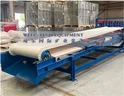
Gravity separator Mineral Processing
1. What is gravity separator beneficiation?
Gravity beneficiation, also known as reselection, is the process of sorting mineral particle groups by density based on the differences in gravity, fluid dynamics, and other mechanical forces experienced by particles in a moving medium due to density differences.
Grain size and shape can affect the accuracy of sorting by density.
What is the basic principle of re-election? What are the applications available?
Gravity beneficiation (referred to as reselection) is one of the main beneficiation methods. It is a process that uses fluid dynamics and various mechanical forces to create suitable loose layering and separation conditions based on the density (usually referred to as specific gravity) or particle size of various minerals, in order to obtain products with different densities or particle sizes. Obviously, mineral particles and shapes will affect the accuracy of density sorting. Due to differences in density or particle size, various mixed mineral particles have different settling velocities and degrees of movement in moving media such as water, heavy media with densities greater than water, and air. The reselection process utilizes this difference to achieve mineral separation, and all reselection processes are based on the settling law of mineral particles in other selected media.
The main forms of movement of mineral particles in the medium are:
① vertical settlement under the action of gravity
② movement within inclined water flow;
③ Separation under vibration and shaking;
④ Fine particles and moving media move together through the gaps of surrounding particles towards the bottom layer (this movement is called "drilling gap").
The theories based on gravity beneficiation include: 】
① sedimentation theory of particles and particle groups;
② The theory of particle groups stratified by density;
③ The theory of particle stratification in swirling flow;
④ The sorting theory of particle groups in inclined flow.
Application of gravity beneficiation; In the Han Dynasty of our country, it was known to use the re-election method to process tin ore. Due to its simplicity, low cost, and increasingly sophisticated development, the re-election method is still the main beneficiation method for tungsten tin ore and coal. It is also widely used in the selection of certain non-ferrous metals, ferrous metals, precious metals, and non-metallic minerals.
The particle size sorting process (such as grading, dehydration, etc.) in gravity beneficiation is almost an indispensable operation in all beneficiation plants.
What are the categories of gravity separator?
There are many types of production processes for reselection, and reselection is divided into six categories based on the different motion forms of the medium and the purpose of the operation, as listed in Table 3-1.
Table 3-1 Classification of Re selection Process
By utilizing mechanical and water flow forces,
Clay is used as an auxiliary operation for mineral processing. Generally, ore contains
When the sedimentation rate (or clay (less than 200 mesh) of mineral particles after washing and dispersing is greater than 10%, it is often necessary to
Divide into different levels for ore washing
1) Preparation work before mineral processing;
Hydraulic grading reduces the velocity (or particle size) into different levels and uses uniform water flow to make the ore particles settle. 3) Used for desliming and dewatering. 2) Used to control the particle size of grinding products;
Jig machine Jigging ore dressing is loose, dense, and layered according to density, thus achieving the utilization of vertical pulsating medium flow to make the ore particle group larger. When processing metal ores, it is generally used to separate smaller and coarser sized minerals, and the upper limit of ore particle size is one of the main re-election methods, which is generally used
Sorted at 20mm

jig machine
shaker table Utilizing the inertial force and inclination of the reciprocating motion of the bed surface is the most successful and effective way to separate fine-grained ores
shaking table One of the methods for selecting minerals with different densities is through the impact of the water flow in the shaking table beneficiation process. The feed particle size is generally 3~Separate 0.037mm

Shaking Table
spiral chute According to the law of mineral particle movement in inclined water flow, it is a relatively simple method of reselection
Based on chute beneficiation, it enables minerals of different densities to be sorted using chutes, which are commonly used for the separation of gold, platinum, and tin sand ores

Rough selection operation of tungsten tin and other ores in the separation mud chute
Heavy medium beneficiation is a beneficiation method or suspension in which mineral particles are sorted by density in a mixture with a relative density greater than 1. Increasing the processing capacity is generally used to remove a large amount of gangue before beneficiation