


The spiral chute is a key gravity separation equipment widely used in mineral processing (e.g., gold, tin, chromium, iron, and coal beneficiation). Its working principle is based on the combined action of gravity, centrifugal force, and fluid drag, which separates minerals of different densities and particle sizes. Below is a detailed, professional breakdown of its working mechanism, tailored for technical communication, sales documentation, or operational training:

1. Core Design & Structural Basis
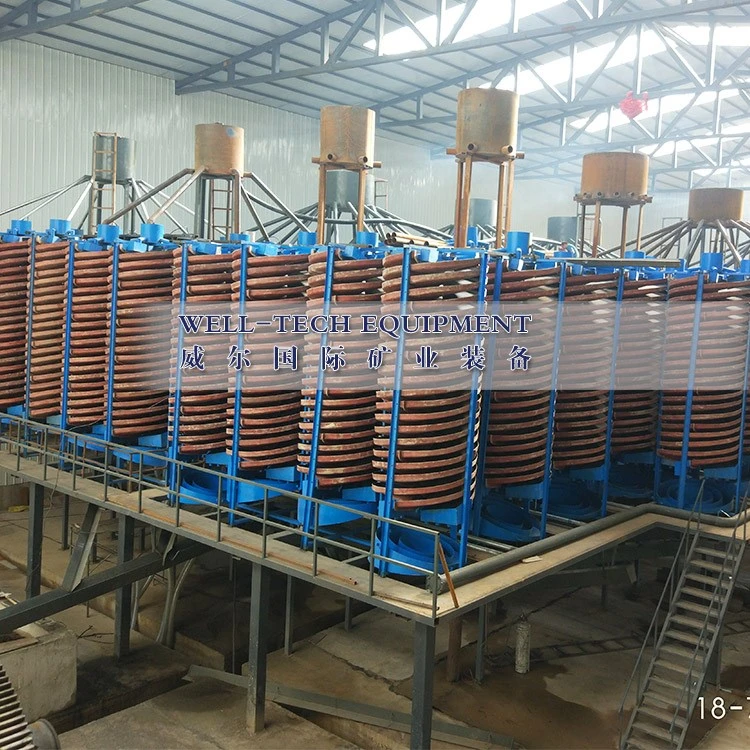
A spiral chute consists of a spiral trough (helical channel), support frame, ore feeding device, concentrate/oil/waste discharge port, and a water supply system. Key structural features supporting its separation principle include:
The spiral trough has a fixed pitch and curvature, with an inclined inner surface (often lined with wear-resistant materials like rubber or polyurethane to reduce friction and protect minerals).
The trough cross-section is typically a "parabolic" or "circular arc" shape, optimizing the flow state of the mineral-water mixture (slurry).
2. Step-by-Step Working Mechanism
(1) Slurry Feeding & Initial Distribution
The crushed and classified mineral slurry (ore particles + water) is uniformly fed into the feeding box at the top of the spiral chute.
Through a distributor, the slurry is introduced into the inner edge of the spiral trough, forming a thin, flowing film along the trough surface (slurry thickness is controlled to 5–20 mm, depending on mineral properties and separation requirements).
(2) Force System Acting on Mineral Particles
As the slurry flows downward along the spiral trough under gravity, each mineral particle is subjected to three critical forces that drive separation:
| Force Type | Source & Effect |
|---|---|
| Gravitational Force (G) | Vertical downward force, determined by the particle's mass (density × volume). |
| Centrifugal Force (Fₙ) | Generated by the spiral motion of the slurry; proportional to the particle's mass and the square of its tangential velocity. Pushes particles toward the outer edge of the trough. |
| Fluid Drag (Fᵈ) | Resistance from the flowing water film; related to the particle's size, shape, and relative velocity to the slurry. Dominates for fine, low-density particles. |
The resultant force of these three forces determines the particle's movement trajectory:
High-density minerals (e.g., gold, chromite, magnetite): Greater gravitational and centrifugal forces overcome fluid drag, moving toward the outer edge of the trough (higher velocity zone).
Low-density gangue minerals (e.g., quartz, feldspar): Weaker resultant force, trapped in the slower-moving inner layer of the slurry, migrating toward the inner edge of the trough.
(3) Stratification & Separation
During the downward spiral flow (typically 3–5 turns), mineral particles undergo dynamic stratification:
The outer edge of the trough collects high-purity, high-density concentrate.
The middle zone (if designed) may produce a "middling" fraction (mixed minerals) for reprocessing.
The inner edge discharges low-density tailings (waste rock).
(4) Product Collection
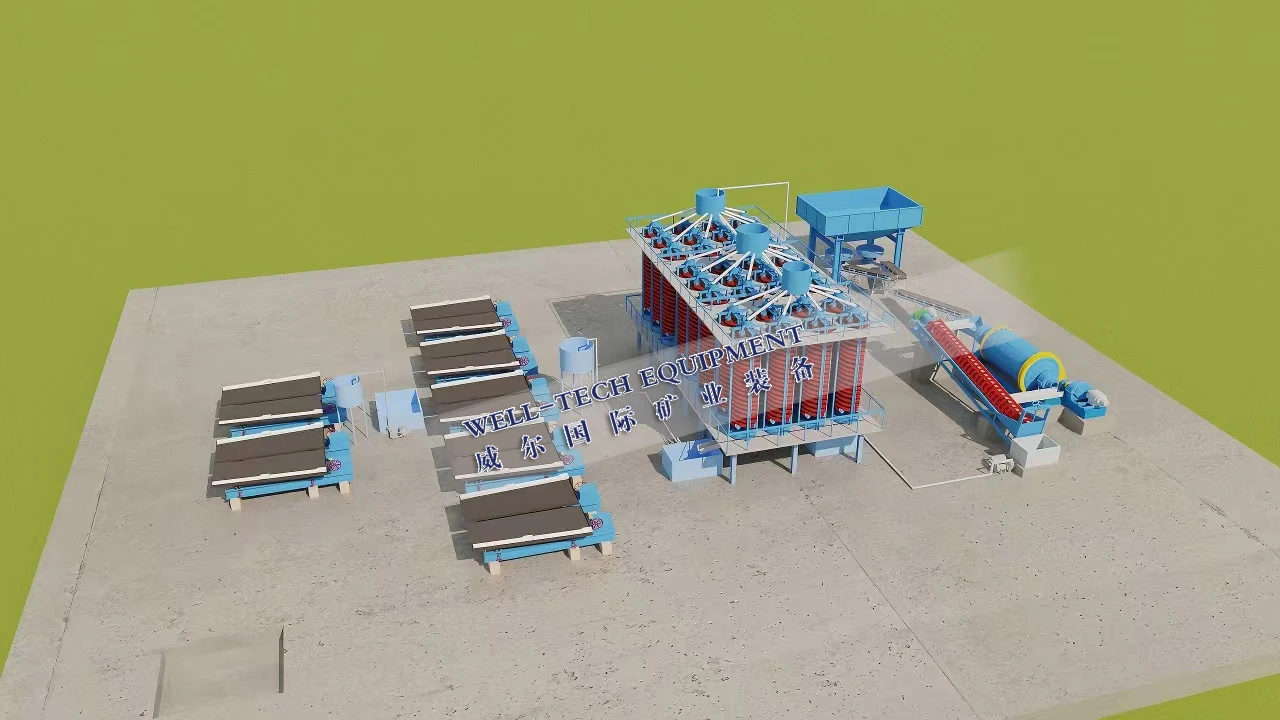
At the bottom of the spiral chute, three separate discharge ports (concentrate, middling, tailings) collect the stratified minerals, completing the separation process.
3. Key Factors Influencing Separation Efficiency
The working principle's effectiveness depends on optimizing the following parameters (critical for technical specifications in quotes or operational guidelines):
Slurry Concentration: 20–40% solids content (varies by mineral); too dilute reduces particle interaction, too thick causes blockages.
Feeding Rate: Uniform flow to avoid disrupting the water film and stratification (typically 1–5 m³/h per chute).
Trough Geometry: Pitch (distance between adjacent spiral turns), curvature radius, and cross-sectional shape (customized for specific minerals).
Water Addition: Supplemental water at the feeding end or along the trough to adjust slurry viscosity and flow velocity.
Particle Size: Optimal for 0.074–2 mm (effective for fine to medium-grained minerals; ultra-fine particles may require auxiliary flotation).

4. Application Characteristics (Linked to Working Principle)
Gravity Separation Advantage: No chemical reagents, low energy consumption, and environmental friendliness (aligns with green beneficiation trends).
High Selectivity: Relies on density differences, making it ideal for separating minerals with distinct specific gravities (e.g., gold vs. quartz, tin ore vs. gangue).
Continuous Operation: Simple structure, easy maintenance, and suitability for large-scale mineral processing plants.
Summary
The spiral chute's working principle revolves around using the resultant force of gravity, centrifugal force, and fluid drag to stratify minerals by density during spiral flow. Its design optimizes particle movement trajectories, enabling efficient separation of valuable minerals from gangue. This principle makes it a core equipment in gravity beneficiation, widely applied in the mining and mineral processing industry for metals (gold, tin, chromium) and non-metallic minerals (coal, zircon).


