


Can spiral gravity separation be used for beneficiation of Tungsten Ore?

Spiral Chute
Yes, it is, and is one of the core mainstream processes for beneficiating tungsten ore (especially in the gravity separation stage of tungsten-tin symbiotic placer deposits and vein tungsten deposits). The core principle is gravity separation, which separates tungsten minerals from gangue.
The spiral process is mainly suitable for these two scenarios in tungsten ore beneficiation, with clear advantages:
• Processing sandy tungsten ore (such as tungsten placer deposits): It can efficiently separate tungsten minerals with a particle size of 0.03-2mm, with low cost and high throughput, suitable for roughing or scavenging, and for pre-enriching tungsten minerals.
• Processing vein tungsten ore (such as wolframite and scheelite): It is often used in conjunction with crushing and grinding processes. In the gravity separation stage, a spiral mill (such as a spiral sluice) is used to separate the ground tungsten minerals, replacing shaking tables and improving separation efficiency.
I will help you outline a simple "spiral process + auxiliary equipment" flow based on specific tungsten ore types (placer deposits/vein deposits). The spiral process has different application flows in the beneficiation of placer tungsten ore and vein tungsten ore, as detailed below:
Placer Tungsten Ore Spiral Process Beneficiation Flowchart
1. Crushing and Screening: The raw ore is coarsely crushed, mediumly crushed, and finely crushed using equipment such as jaw crushers, and then classified using vibrating screens to ensure the ore particle size meets the requirements for subsequent beneficiation.
2. Spiral Separation: The classified ore is made into a slurry and fed into a spiral separator. Spiral separation utilizes the rotation of the spiral blades to separate the ore under the combined action of centrifugal force and gravity. Denser tungsten minerals are concentrated near the inner side of the slurry, while less dense gangue and other impurities are carried away by the water flow to the outer side.
3. Centrifugal Separation: The fine-grained ore after spiral separation enters a centrifugal separator. The powerful centrifugal force field generated by high-speed rotation further effectively separates the finer tungsten minerals, yielding the final tungsten concentrate.

Spiral Concentration Process for Vein Tungsten Ore Beneficiation
1. Crushing and Grinding: The vein tungsten ore is first crushed using a jaw crusher, then ground in a ball mill. The grinding product typically achieves a particle size of -0.5mm, with about 70% being tungsten, ensuring sufficient liberation of the tungsten minerals.
2. Slurry Preparation and Feeding: The ground slurry is fed into a mixing tank and adjusted to a concentration of 25%-30%, then fed by gravity into a spiral sluice.
3. Spiral Sluice Separation: The slurry rotates and slides down the spiral sluice. Under the influence of centrifugal force, gravity, and water shear force, the denser wolframite particles aggregate and settle towards the inner edge, forming a concentrate belt. The lighter gangue is pushed towards the outer edge of the sluice as tailings.
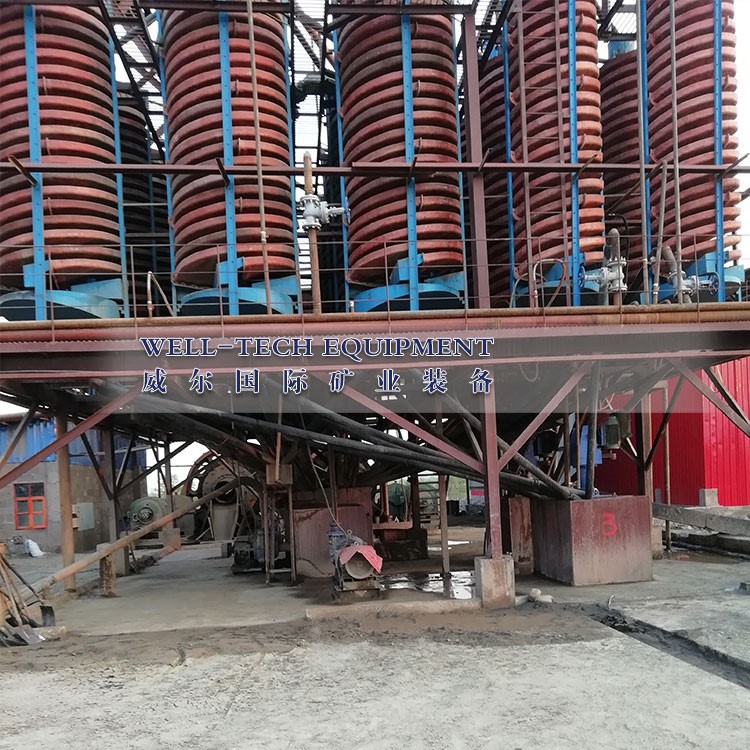
4. Further Refinement: The concentrate obtained from the spiral sluice can be further refined using processes such as shaking tables, flotation, and magnetic separation to improve the grade of the tungsten concentrate. However, not all tungsten ore is suitable for strong magnetic separation. The key factor is the type of tungsten ore (wolfonite/scheelite). Essentially, it utilizes the combined effects of magnetic and density differences between the tungsten minerals and gangue for separation.
In the beneficiation of tungsten ore, strong magnetic separation is primarily used in two scenarios, with significantly different applicability:
• **Prioritized for wolframite:** Wolframite itself is weakly magnetic, while the gangue (such as quartz and feldspar) is mostly non-magnetic. Strong magnetic separators (such as vertical ring strong magnetic separators) can first separate most of the non-magnetic gangue, followed by water separation (such as spiral or shaking table) for enrichment. This improves subsequent separation efficiency and reduces costs, a common process for wolframite. Black tungsten concentrate can be obtained by gravity separation followed by a combination of strong magnetic separation/gangue removal and water enrichment.
• Rarely used for scheelite:** Scheelite is a non-magnetic mineral with very little magnetic difference from most gangue. Strong magnetic separation cannot effectively separate it, and forced use would lead to significant loss of tungsten minerals. Scheelite is better suited for gravity separation followed by flotation or shaking table water purification, rather than strong magnetic separation, to obtain the final tungsten concentrate.


