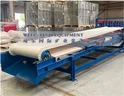
The core process of coastal placer ore washing involves raw ore pretreatment → roughing by gravity separation → fine separation by gravity/magnetic separation → combined magnetic and electric purification → drying of finished products. It is suitable for the separation of heavy minerals such as ilmenite, zircon, rutile, and monazite.

Trommel Screen
1. Pre-treatment of raw ore (core of ore washing): screening and impurity removal: Use a shaftless roller screen (with a mesh size of 5–10mm) or a vibrating screen to separate large impurities such as gravel and shells, protecting subsequent equipment.
Ore washing and desliming: Use a spiral ore washer or a trough scrubber, add water, and scrub to remove clay, fine mud, and organic matter; control the pulp concentration at 25%–35% to avoid the impact of mud on separation.
Hydraulic classification: Utilize a spiral classifier or a hydrocyclone to classify particles based on their size, providing qualified particle size materials for gravity separation.

Spiral Chute
II. Core equipment for gravity and roughing (pre-enrichment, key to cost reduction): spiral chute (mainstream), jig, and cone concentrator.
Process key points: Leverage the density difference, allowing heavy minerals (such as ilmenite and zircon) to accumulate along the inner edge, while light minerals (such as quartz) are carried away by the water flow; over 70% of the tailings can be discarded, significantly reducing the subsequent processing workload.
Particle size adaptation: coarse particles are processed using jigs or centrifuges, fine particles are processed using spiral chutes, and extremely fine particles are processed using centrifugal concentrators.
III. Refinement and upgrading (grade improvement) through gravity separation and concentration: The coarse concentrate enters the 6S shaking table, where light impurities are further removed through table surface vibration and lateral water flow, thereby improving the grade of the heavy minerals.
Magnetic separation: Weak magnetic separation (0.5–1.0T): Separate weakly magnetic minerals such as ilmenite.
High-intensity magnetic separation (1.0–1.5T): Recover weakly magnetic minerals such as monazite.
Wet magnetic separation is suitable for slurry, while dry magnetic separation is suitable for dry materials. Choose according to your needs.
Electro-separation purification: The magnetic separation tailings (zircon sand + rutile) are separated by a high-voltage electro-separator based on conductivity differences; the moisture content of the material must be **<1%**, and the environmental temperature and humidity are strictly controlled.
Auxiliary purification (optional): When the grade does not meet the standard, further purification can be achieved through reverse flotation.

Dry magnetic separator

Electrostatic Separator
4. Drying and finished product selection: The concentrate is dehydrated to **≤0.5%** through a rotary dryer/airflow dryer, packaged, and stored for ease of storage and foreign trade delivery.
V. Tailings treatment: After concentration and clarification, the tailings slurry is transported to the tailings pond for storage; valuable components can be further selected and recycled to enhance resource utilization.
VI. Typical combination process (titanium-zirconium sand ore) raw ore → drum screening → spiral chute roughing → table concentration → low-intensity magnetic separation to remove ilmenite → high-intensity magnetic separation to remove monazite → high-voltage electrostatic separation to separate zircon and rutile → drying → finished product.
VII. Key parameters and essential granularity control: The suitable granularity range for gravity separation is 0.074–2mm. Coarse particles should be processed using jigging or centrifuges, while fine particles should be processed using shaking tables.
Pulp concentration: 25%–35% for ore washing, 30%–40% for gravity separation, ensuring stratification effect.
Equipment selection: Prioritize the use of high-capacity and low-cost gravity separation equipment for rough separation, followed by magnetic-electric combined purification.